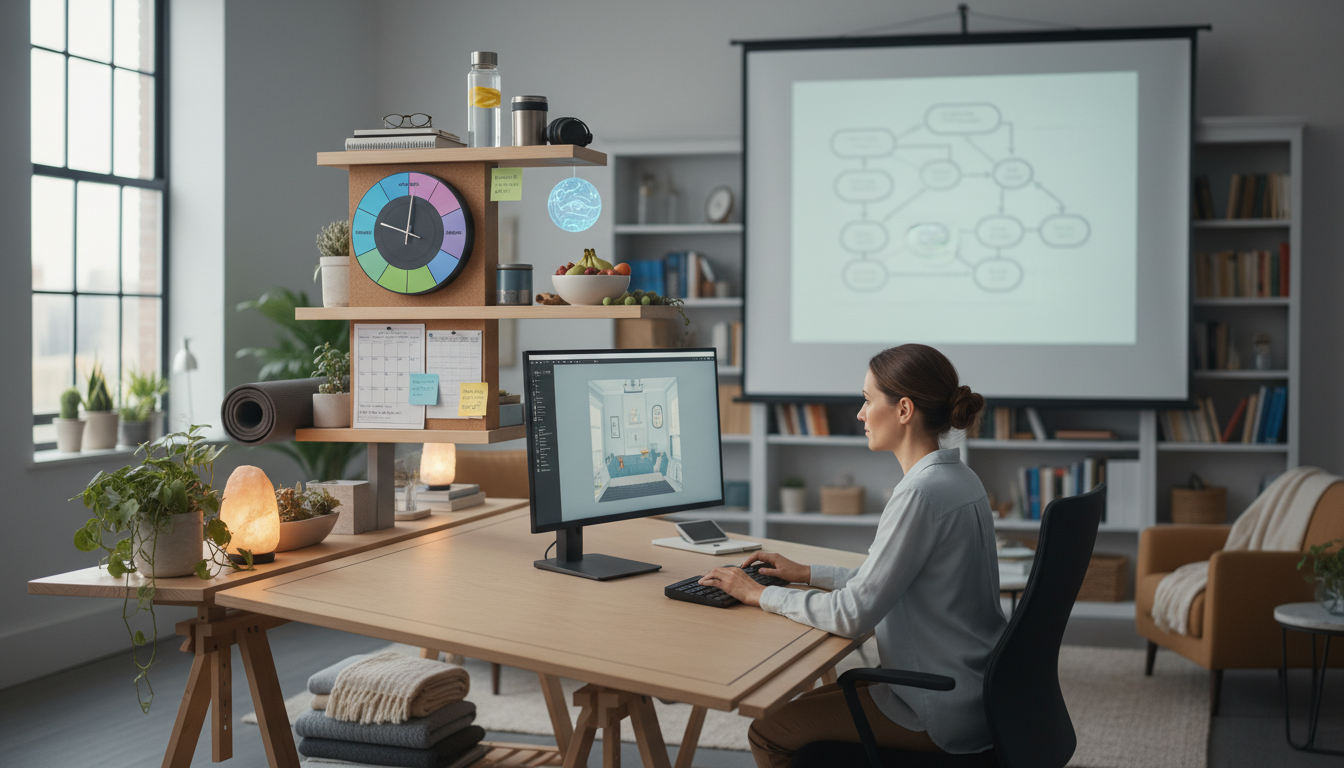
The 4-Layer Productivity System: How Elite Remote Workers Structure Their Days for Deep Work and Sustainable Performance
Your home office feels like a productivity trap. Despite having every tool imaginable and zero commute, you’re producing less meaningful work than when you sat in a cubicle. The constant stream of Slack messages, the blurred boundaries between work and life, and the invisible pressure to be “always on” have turned remote work from dream to drain.
You’re not alone. According to Microsoft’s Work Trend Index, 42% of remote workers report multitasking during meetings has increased, while 28% struggle to focus on core priorities. The promise of remote work productivity has collided with a harsh reality: without proper structure, flexibility becomes chaos.
Elite remote workers—those who’ve sustained high performance for five or more years—operate differently. Through analyzing the practices of senior engineers at distributed companies, successful solopreneurs generating seven-figure revenues, and remote team leaders managing global operations, a clear pattern emerges. They don’t chase productivity hacks. They build interconnected systems across four critical layers that compound their effectiveness while preventing burnout.
Layer 1: Environmental Architecture
Physical space directly influences cognitive performance. Research from Harvard Business Review shows that dedicated workspaces improve focus by 32% and reduce work-life conflict by 25%. Elite remote workers treat their environment as a productivity multiplier, not an afterthought.
The Three-Zone Principle
Top performers divide their living space into three distinct zones:
Focus Zone: A space designed exclusively for deep work. No phones, minimal décor, optimized lighting. Senior software engineer Sarah Chen, who’s worked remotely for GitHub since 2018, maintains a spartan home office: “Every object in my focus zone has a purpose. If it doesn’t directly support deep work, it doesn’t belong there.”
Collaboration Zone: A separate area for video calls and interactive work. This zone includes better lighting for video, a curated background, and quick access to collaboration tools. Having a distinct collaboration space prevents the mental residue of meetings from contaminating deep work sessions.
Restoration Zone: A third space completely disconnected from work. This might be a reading corner, exercise area, or outdoor space. The key is physical separation that triggers mental disconnection.
Environmental Triggers
Elite performers use environmental cues to prime specific mental states:
- Lighting schedules: Bright, cool light for analytical work; warm, dimmer light for creative tasks
- Scent associations: Specific essential oils or candles that signal “deep work mode”
- Sound signatures: Particular playlists or ambient noise for different work types
- Temperature control: Slightly cool environments (68-70°F) for sustained focus
Layer 2: Temporal Design
Time management for elite remote workers goes beyond calendar blocking. They design their days around energy rhythms and cognitive peaks, not arbitrary schedules.
Chronotype Alignment
Research from the Journal of Applied Psychology demonstrates that aligning work with natural chronotypes can improve performance by up to 30%. Elite remote workers identify their cognitive peaks and protect them fiercely:
Morning Larks (25% of population): Schedule deep work from 6-10 AM, meetings after 2 PM
Night Owls (25% of population): Reserve mornings for administrative tasks, deep work from 4-8 PM
Third Birds (50% of population): Two peaks at 10 AM and 5 PM, with a significant afternoon dip
The 90-Minute Rule
Based on ultradian rhythms, elite performers work in 90-minute focused blocks followed by 20-minute recovery periods. Marcus Johnson, a remote marketing director who’s led distributed teams for eight years, structures his entire day around this principle: “I get more done in three 90-minute blocks than I used to in 10 hours of reactive work.”
Boundary Rituals
Without physical commutes, remote workers need manufactured transitions:
- Morning activation: 10-minute routine that signals work start (specific coffee ritual, brief walk, journaling)
- Mode switches: 5-minute transitions between deep work and collaborative work
- Evening shutdown: 15-minute routine that creates psychological distance from work
Layer 3: Energy Management
Sustainable high performance requires managing four types of energy:
Physical Energy
Elite remote workers treat physical vitality as a performance foundation. SHRM research indicates that remote workers who maintain consistent exercise routines report 40% higher sustained productivity.
Key practices include:
– Movement snacks every 90 minutes (5-minute walks, stretching, or calisthenics)
– Standing desk intervals (25% of work time standing)
– Hydration systems (water bottle refills as transition rituals)
– Nutrition timing (light meals during focus blocks, substantial meals during breaks)
Mental Energy
Cognitive load management separates elite performers from those who burn out:
Decision Batching: Grouping similar decisions together to preserve mental energy for complex work
Information Diets: Limiting news consumption to specific windows, avoiding morning social media
Context Minimization: Reducing the number of active projects to maintain deeper focus
Emotional Energy
Remote work can be emotionally draining without proper boundaries. Top performers maintain emotional reserves through:
- Asynchronous communication preferences (reducing the emotional labor of constant availability)
- “Office hours” for non-urgent requests
- Regular peer connections for emotional support and validation
Spiritual Energy
Connection to purpose drives sustainable performance. Elite remote workers regularly reconnect with their “why” through:
– Weekly reflection sessions on impact and progress
– Monthly alignment checks between daily work and long-term goals
– Quarterly “purpose audits” to ensure work remains meaningful
Layer 4: Attention Architecture
The final layer—and the most critical—involves designing systems that protect and direct attention toward high-value work.
The Hierarchy of Focus
Cal Newport’s research on knowledge workers shows that those who can maintain deep focus for 4+ hours daily produce exponentially more valuable output. Elite remote workers structure their attention hierarchically:
Tier 1 – Deep Work (4 hours/day): Complex problem-solving, creative work, strategic thinking
Tier 2 – Shallow Work (2 hours/day): Email, administrative tasks, routine decisions
Tier 3 – Collaborative Work (2 hours/day): Meetings, brainstorming, team coordination
Attention Residue Elimination
Task-switching costs productivity, with research from UC Irvine showing it takes an average of 23 minutes to fully refocus. Elite performers eliminate attention residue through:
- Single-tab browsing during deep work
- Phone in another room (not just on silent)
- Email/Slack checks at predetermined times only
- “Capture lists” for random thoughts during focus sessions
The Weekly Architecture Review
Every Sunday, top performers spend 30 minutes reviewing and adjusting their four-layer system:
- Environmental audit: What spaces supported or hindered focus?
- Temporal analysis: Which time blocks yielded highest-quality output?
- Energy assessment: Where did energy leak or surge?
- Attention review: What pulled focus unnecessarily?
Integration: Making the Layers Work Together
The power of this system lies not in individual layers but in their integration. When environmental design supports temporal rhythms, when temporal rhythms align with energy patterns, and when energy management enables sustained attention—productivity becomes effortless rather than forced.
Jennifer Martinez, a remote product manager who’s led distributed teams at three unicorn startups, explains: “Once I aligned all four layers, work stopped feeling like work. I accomplish more by 2 PM than I used to in a full day, and I’m energized rather than depleted.”
The Compound Effect
Implementing this four-layer system requires initial investment—typically 2-3 weeks of adjustment. However, LinkedIn’s Global Talent Trends data shows that remote workers who develop structured systems report 3x higher job satisfaction and 2.5x lower burnout rates.
The key is starting with one layer and building systematically. Most elite performers recommend beginning with Environmental Architecture, as physical changes create immediate psychological shifts that support the other layers.
Beyond Individual Performance
This framework scales beyond individual contributors. Remote team leaders use these principles to design team rhythms, create virtual environments that support different work modes, and help team members optimize their own four-layer systems.
The future of remote work isn’t about better tools or more flexibility—it’s about intentional design across all dimensions of the work experience. Those who master this four-layer system don’t just survive remote work; they use it as a competitive advantage to produce their best work while living their best lives.
The question isn’t whether you can afford to implement this system. Given the trajectory of distributed work, the question is whether you can afford not to.
Continue Reading
- How to Overcome Imposter Syndrome and Succeed
- Companies Leading the Way in Employee Development
- The Complete Job Search Strategy Guide
Frequently Asked Questions
Q: How long should each layer of the 4-layer productivity system take during a typical workday?
Most elite remote workers allocate approximately 60% of their day to deep work (Layer 1), 20% to collaborative tasks (Layer 2), 10% to administrative work (Layer 3), and 10% to planning and reflection (Layer 4). However, these percentages should flex based on your role—software developers might dedicate more time to deep work, while managers may need additional time for Layer 2 collaboration.
Q: Can I implement the 4-layer system if my job requires frequent interruptions and meetings?
Yes, you can adapt the system by time-blocking your most critical deep work during your least-interruptible hours, then clustering meetings and collaborative work into designated blocks. Set clear boundaries by updating your calendar to show unavailable times during deep work periods, and communicate these blocks to your team so they respect your focused time.
Q: What’s the best way to transition between layers without losing momentum?
Use a 5-10 minute buffer between layers to physically shift your environment or mentally reset—close tabs, review your next layer’s priorities, or take a brief walk. This prevents context-switching fatigue and helps your brain prepare for different types of cognitive demands, whether you’re moving from deep work to meetings or administrative tasks to planning.
Q: How do I know if the 4-layer system is actually improving my productivity?
Track metrics specific to each layer for 2-3 weeks: measure deep work output (completed projects or features), meeting effectiveness (decisions made or problems solved), administrative turnaround times (emails processed, tasks completed), and planning quality (weekly goals met). Compare these baseline metrics monthly to identify which layers need adjustment and whether your overall output and job satisfaction are increasing.
Q: Should I use the same layer schedule every day, or vary it based on my workload?
Establish a consistent core structure (most people find mornings ideal for Layer 1 deep work), but allow flexibility day-to-day based on project deadlines and meeting demands. Plan your layer sequence weekly—for example, dedicate Mondays to heavy planning and Fridays to reflection—while keeping your deepest work during your peak energy hours regardless of the day.