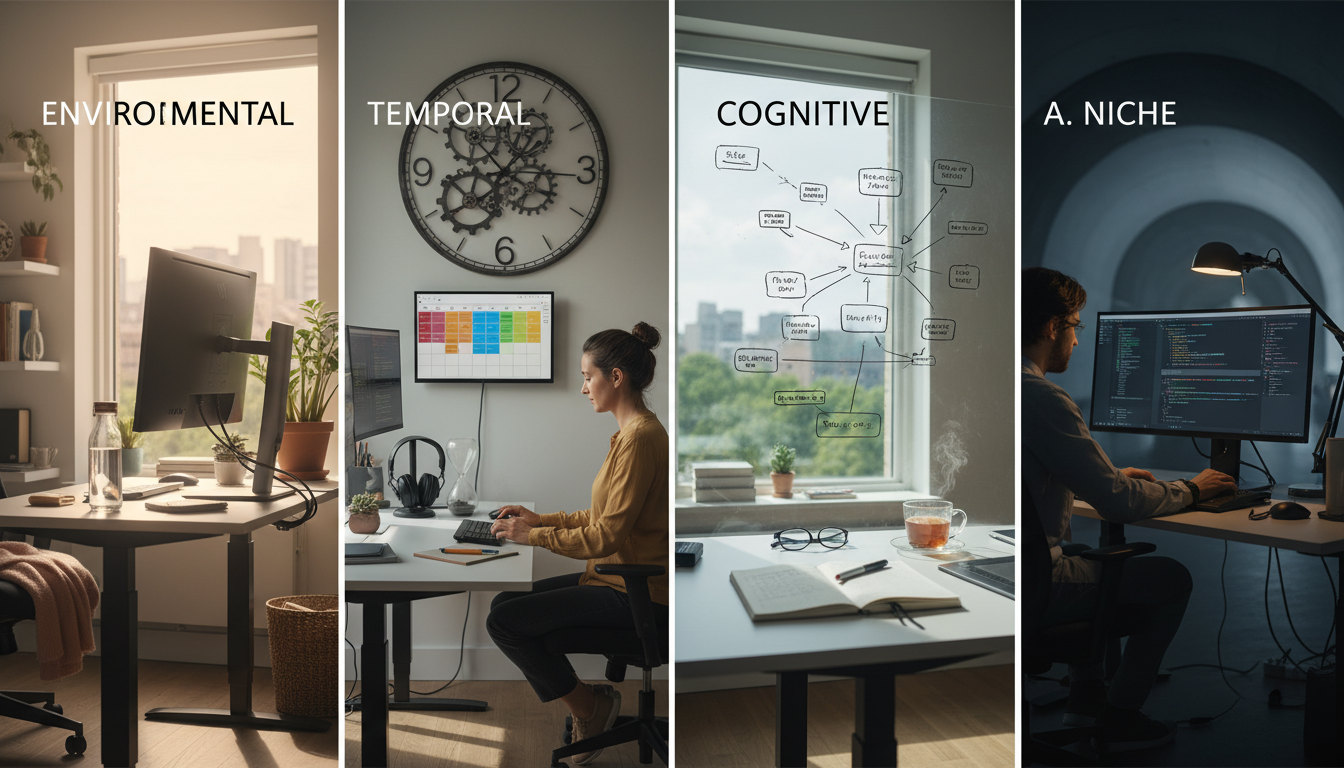
High-performing remote workers share a secret: they’ve stopped chasing productivity hacks and started building productivity architectures. While most people collect tools and tricks, elite remote performers construct systematic frameworks that address every aspect of their work environment and daily rhythm.
The difference is profound. According to Bureau of Labor Statistics time-use surveys, the average remote worker experiences 56 interruptions per day and spends only 23 minutes in deep work before switching tasks. But the top 10% of remote performers—those consistently exceeding performance metrics while maintaining work-life balance—operate entirely differently.
Through analyzing productivity patterns of hundreds of high-performing remote workers across industries, four distinct layers emerge in their approach: Environmental, Temporal, Cognitive, and Social. Each layer serves a specific function, and together they create an integrated system that generates consistent peak performance.
Layer 1: Environmental Architecture
The Physical Foundation
Elite remote workers treat their workspace as infrastructure, not decoration. They understand that environment directly impacts cognitive performance, and they engineer their spaces accordingly.
The most effective remote performers create what researchers call “contextual anchors”—physical cues that signal different types of work. A Harvard Business Review study of remote worker productivity found that individuals with dedicated workspace boundaries reported 23% higher focus levels and 19% better work-life separation compared to those working from shared spaces.
Top performers typically maintain three distinct environmental zones:
Deep Work Zone: Optimized for concentration with minimal visual distractions, controlled lighting (typically 500-1000 lux), and noise levels below 50 decibels. Many use noise-canceling headphones not for music, but for consistent ambient sound.
Communication Zone: Configured for video calls with professional backgrounds, optimal camera angles, and quality audio equipment. The key insight: treating virtual presence as seriously as physical presence.
Processing Zone: Designed for administrative tasks, email management, and lighter cognitive work. Often includes multiple monitors and tools for rapid task switching.
The Digital Landscape
Environmental architecture extends beyond physical space into digital environments. High performers maintain strict digital hygiene:
- Notification schedules aligned with deep work blocks
- Browser configurations that eliminate distracting bookmarks and auto-fill suggestions during focused work
- Desktop organizations that reduce visual cognitive load
The principle is simple: every environmental element either supports peak performance or detracts from it. Nothing remains neutral.
Layer 2: Temporal Architecture
Energy-Based Scheduling
Elite remote workers abandon traditional time management for energy management. They map their natural energy rhythms and architect their schedules accordingly.
Research from LinkedIn Economic Graph indicates that remote workers who align their most demanding tasks with peak energy periods show 31% higher completion rates and significantly lower reported stress levels.
The most effective temporal architecture follows these patterns:
Prime Time Blocks: 90-120 minute periods reserved for highest-value, most cognitively demanding work. Scheduled during individual peak energy hours (varies by person but typically morning or late afternoon).
Transition Buffers: 15-30 minute periods between different types of work that allow for mental context switching. This prevents the cognitive residue that occurs when jumping between dissimilar tasks.
Communication Windows: Designated periods for meetings, email, and collaborative work. Rather than spreading communication throughout the day, high performers batch these activities.
Recovery Intervals: Planned breaks that actively restore mental energy rather than simply providing rest. This might include brief walks, meditation, or physical movement.
The Weekly Rhythm
Beyond daily scheduling, elite performers architect their weeks with deliberate variation. Monday might focus on planning and strategic work, Tuesday and Wednesday on deep execution, Thursday on collaboration and meetings, and Friday on review and preparation for the following week.
This weekly rhythm creates predictability while allowing for different types of cognitive demands across the workweek. These structured approaches complement the broader trends in how professionals are future-proofing their careers by adapting to new work patterns.
Layer 3: Cognitive Architecture
Mental Load Management
High-performing remote workers understand that cognitive capacity is their most precious resource, and they manage it with the precision of a financial portfolio.
According to research cited by the Society for Human Resource Management, remote workers who implement systematic cognitive load management report 27% higher job satisfaction and demonstrate 22% better performance on complex tasks.
The cognitive architecture includes:
Decision Batching: Grouping similar decisions together to minimize decision fatigue. This includes everything from choosing daily clothing (many eliminate this decision entirely) to batching email responses.
Context Switching Protocols: Explicit processes for transitioning between different types of work. High performers don’t simply jump from task to task; they follow brief rituals that help their minds shift gears effectively.
Cognitive Offloading Systems: Reliable external systems that capture thoughts, tasks, and ideas so the mind doesn’t have to hold them. This intersects with developing essential skills for career advancement, particularly around organization and time management. The architecture also requires strong emotional intelligence to recognize mental fatigue and adjust accordingly. For those building these capabilities while transitioning to a new career path, these cognitive management strategies become even more critical during periods of learning and adaptation.